+EIROPAS PARLAMENTA UN PADOMES REGULA (EK) Nr. 66/2010 (2009. gada 25. novembris) par ES ekomarķējumu (Dokuments attiecas uz EEZ)
---+1. pants Priekšmets
---+2. pants Piemērošanas joma
------+Article 2 1.
------+Article 2 2.
---+3. pants Definīcijas
---+4. pants Kompetentās iestādes
------+Article 4 1.
------+Article 4 2.
------+Article 4 3.
------+Article 4 4.
---+5. pants Eiropas Savienības Ekomarķējuma komiteja
------+Article 5 1.
------+Article 5 2.
---+6. pants Vispārīgas prasības saistībā ar ES ekomarķējuma kritērijiem
------+Article 6 1.
------+Article 6 2.
------+Article 6 3.
------+Article 6 4.
------+Article 6 5.
------+Article 6 6.
------+Article 6 7.
---+7. pants ES ekomarķējuma kritēriju izstrāde un pārskatīšana
------+Article 7 1.
------+Article 7 2.
------+Article 7 3.
------+Article 7 4.
---+8. pants ES ekomarķējuma kritēriju noteikšana
------+Article 8 1.
------+Article 8 2.
------+Article 8 3.
------+Article 8 4.
---+9. pants ES ekomarķējuma piešķiršana un tā izmantošanas noteikumi un nosacījumi
------+Article 9 1.
------+Article 9 2.
------+Article 9 3.
------+Article 9 4.
------+Article 9 5.
------+Article 9 6.
------+Article 9 7.
------+Article 9 8.
------+Article 9 9.
------+Article 9 10.
------+Article 9 11.
------+Article 9 12.
------+Article 9 13.
---+10. pants Tirgus uzraudzība un ES ekomarķējuma izmantošanas kontrole
------+Article 10 1.
------+Article 10 2.
------+Article 10 3.
------+Article 10 4.
------+Article 10 5.
------+Article 10 6.
---+11. pants Ekomarķējuma sistēmas dalībvalstīs
------+Article 11 1.
------+Article 11 2.
---+12. pants ES ekomarķējuma popularizēšana
------+Article 12 1.
------+Article 12 2.
------+Article 12 3.
---+13. pants Informācijas un pieredzes apmaiņa
------+Article 13 1.
------+Article 13 2.
---+14. pants Ziņojums
---+15. pants Pielikumu grozīšana
---+16. pants Komitejas procedūra
------+Article 16 1.
------+Article 16 2.
---+17. pants Sankcijas
---+18. pants Atcelšana
---+19. pants Pārejas noteikumi
---+20. pants Stāšanās spēkā
---+ANNEX I PROCEDURE FOR THE DEVELOPMENT AND REVISION OF EU ECOLABEL CRITERIA
---+II PIELIKUMS
---+III PIELIKUMS
---+ANNEX IV STANDARD CONTRACT COVERING THE TERMS OF USE OF THE EU ECOLABEL
---+ANNEX V REQUIREMENTS RELATING TO COMPETENT BODIES
|
English -
European Union -
Environment -
EIROPAS PARLAMENTA UN PADOMES REGULA (EK) Nr. 66/2010 (2009. gada 25. novembris) par ES ekomarķējumu (Dokuments attiecas uz EEZ)
EIROPAS PARLAMENTA UN PADOMES REGULA (EK) Nr. 66/2010 (2009. gada 25. novembris) par ES ekomarķējumu (Dokuments attiecas uz EEZ) 1. Pārskats
| Nosaukums |
Regulējums |
|
1. pants Priekšmets
|
1. pants Priekšmets Ar šo regulu paredz noteikumus par brīvprātīgas ES ekomarķējuma sistēmas izveidi un piemērošanu. |
|
2. pants Piemērošanas joma
|
2. pants Piemērošanas joma 1. Šo regulu piemēro ikvienai precei vai pakalpojumam, ko Kopienas tirgū par atlīdzību vai bez maksas piegādā vai sniedz izplatīšanai, patēriņam vai lietošanai (turpmāk “produkti”). 2. Šo regulu nepiemēro ne cilvēkiem paredzētām zālēm, kā noteikts Eiropas Parlamenta un Padomes Direktīvā 2001/83/EK (2001. gada 6. novembris) par Kopienas kodeksu, kas attiecas uz cilvēkiem paredzētām zālēm (
1
), ne veterinārajām zālēm, kā noteikts Eiropas Parlamenta un Padomes Direktīvā 2001/82/EK (2001. gada 6. novembris) par Kopienas kodeksu, kas attiecas uz veterinārajām zālēm (
2
), ne arī jebkura veida medicīnas ierīcēm. |
|
3. pants Definīcijas
|
3. pants Definīcijas Šajā regulā piemēro šādas definīcijas:
1) “produktu grupa” ir produktu kopums, kurus izmanto līdzīgiem mērķiem un kuri ir līdzīgi no lietošanas viedokļa, vai kuriem ir līdzīgas funkcionālas īpašības un kuri ir līdzīgi no patērētāju uztveres viedokļa;
2) “uzņēmējs” ir jebkurš ražotājs, izgatavotājs, importētājs, pakalpojumu sniedzējs, vairumtirgotājs vai mazumtirgotājs;
3) “ietekme uz vidi” ir jebkādas izmaiņas vidē, kuras pilnīgi vai daļēji izraisījis produkts sava aprites cikla laikā;
4) “ekoloģiskie raksturlielumi” ir ražotāja panāktie rezultāti, strādājot pie tām produkta īpašībām, kurām ir ietekme uz vidi;
5) “pārbaude” ir procedūra, lai apliecinātu, ka produkts atbilst konkrētiem ES ekomarķējuma kritērijiem.
|
|
4. pants Kompetentās iestādes
|
4. pants Kompetentās iestādes 1. Katra dalībvalsts norīko par šajā regulā paredzēto uzdevumu izpildi atbildīgo iestādi vai iestādes valsts ministrijās vai ārpus tām (turpmāk “atbildīgā iestāde” vai “atbildīgās iestādes”) un nodrošina, ka tās spēj darboties. Ja norīko vairākas kompetentās iestādes, tad attiecīgā dalībvalsts nosaka to pilnvaras un tām piemērojamās koordinācijas prasības. 2. Kompetento iestāžu struktūra ir tāda, kas garantē to neatkarību un neitralitāti, un to reglaments ir tāds, kas nodrošina veikto pasākumu pārredzamību, kā arī visu ieinteresēto personu iesaistīšanos. 3. Dalībvalstis nodrošina, ka kompetentās iestādes atbilst V pielikumā noteiktajām prasībām. 4. Kompetentās iestādes nodrošina, ka pārbaudes procesu konsekventi, neitrāli un uzticami veic no pārbaudāmā uzņēmēja neatkarīga puse, pamatojoties uz starptautiskiem, Eiropas vai attiecīgās valsts standartiem un procedūrām attiecībā uz iestādēm, kuras pārvalda produktu sertifikācijas sistēmas. |
|
5. pants Eiropas Savienības Ekomarķējuma komiteja
|
5. pants Eiropas Savienības Ekomarķējuma komiteja 1. Komisija izveido Eiropas Savienības Ekomarķējuma komiteju (ESEK), kuras sastāvā ir pārstāvji no visu dalībvalstu kompetentām iestādēm un citām ieinteresētām personām, kā minēts 4. pantā. ESEK ievēl priekšsēdētāju saskaņā ar tās reglamentu. ESEK piedalās ES ekomarķējuma kritēriju izstrādē un pārskatīšanā, kā arī jebkādā ES ekomarķējuma sistēmas īstenošanas pārskatīšanā. Turklāt tā konsultē Komisiju šajos jautājumos un palīdz tai, jo īpaši sniedzot ieteikumus par obligātajām prasībām attiecībā uz ekoloģiskajiem raksturlielumiem. 2. Komisija nodrošina, lai ESEK darbībā tiktu ievērota visu ar katru attiecīgo produktu grupu saistīto ieinteresēto personu samērīga līdzdalība, tostarp kompetento iestāžu, izgatavotāju, ražotāju, importētāju, pakalpojumu sniedzēju, vairumtirgotāju, mazumtirgotāju, jo īpaši MVU, un vides aizsardzības grupu un patērētāju organizāciju līdzdalība. |
|
6. pants Vispārīgas prasības saistībā ar ES ekomarķējuma kritērijiem
|
6. pants Vispārīgas prasības saistībā ar ES ekomarķējuma kritērijiem 1. ES ekomarķējuma kritēriju pamatā ir produktiem piemērojamie ekoloģiskie raksturlielumi un Kopienas jaunākie stratēģiskie mērķi vides jomā. 2. ES ekomarķējuma kritērijos ietver vides prasības, atbilstoši kurām produktu vērtē, lai lemtu par ES ekomarķējuma piešķiršanu. 3. ES ekomarķējuma kritērijus nosaka, pamatojoties uz zinātniskiem pierādījumiem un ņemot vērā visu produktu aprites ciklu. Nosakot šādus kritērijus, novērtē:
a) būtiskākos vidi ietekmējošus faktorus produkta aprites ciklā, jo īpaši ietekmi uz klimata pārmaiņām, iespaidu uz dabu un bioloģisko daudzveidību, enerģijas un resursu patēriņu, radīto atkritumu apjomu, visu veidu emisijas vidē un piesārņojumu, ko rada bīstamu vielu fizikālie faktori kā arī izmantošana un noplūde;
b) kaitīgu vielu aizstāšanu ar mazāk kaitīgāk vielām kā tādām vai ar alternatīvu materiālu izmantošanu vai dizaina maiņu, kad tas ir tehniski iespējams;
c) iespēju samazināt ietekmi uz vidi produktu ilglaicīguma un otrreizējas izmantošanas dēļ;
d) neto starpību starp videi radītajiem ieguvumiem un apgrūtinājumiem, tostarp veselības un drošības aspektus, dažādos konkrēto produktu aprites posmos;
e) sociālos un ētikas aspektus, piemēram, sniedzot atsauci uz atbilstošajām starptautiskajām konvencijām un nolīgumiem, piemēram, attiecīgajiem SDO standartiem un rīcības kodeksiem;
f) produktu grupas ekomarķējuma kritērijus, kas izveidoti citiem vides marķējumiem, īpaši oficiāli atzītus valsts vai reģionu mērogā – EN ISO 14024 I tipa vides marķējumus – ja tie eksistē konkrētai produktu grupai, lai uzlabotu sinerģiju;
g) cik iespējams - mērķi samazināt izmēģinājumus uz dzīvniekiem.
4. ES ekomarķējuma kritērijos ietver prasības, kuru mērķis ir nodrošināt, lai produkti, kuriem ir ES ekomarķējums, pienācīgi funkcionētu atbilstoši tiem paredzētajam izmantošanas veidam. 5. Pirms ES ekomarķējuma kritēriju izstrādes pārtikas un barības produktiem, kā noteikts Eiropas Parlamenta un Padomes Regulā (EK) Nr. 178/2002 (2008. gada 28. janvāris), ar ko paredz pārtikas aprites tiesību aktu vispārīgus principus un prasības, izveido Eiropas Pārtikas nekaitīguma iestādi un paredz procedūras saistībā ar pārtikas nekaitīgumu (
3
), Komisija, vēlākais, līdz 2011. gada 31. decembrim veic pētījumu, izpētot iespēju ieviest ticamus kritērijus attiecībā uz ekoloģiskajiem raksturlielumiem visā šādu produktu aprites ciklā, tostarp zivsaimniecības un lauksaimniecības produktiem. Pētījumā īpaša uzmanība būtu jāpievērš ES ekomarķējuma kritēriju ietekmei uz pārtikas un barības produktiem, kā arī neapstrādātiem lauksaimniecības produktiem, kas iekļauti Regulas (EK) Nr. 834/2007 darbības jomā. Pētījumā būtu jāapsver iespēja, ka - lai neradītu neizpratni patērētājiem - ES ekomarķējumu var piešķirt vienīgi produktiem, kas ir sertificēti kā bioloģiskie produkti. Ņemot vērā pētījuma rezultātu un ESEK atzinumu, Komisija saskaņā ar 16. panta 2. punktā minēto regulatīvo kontroles procedūru pieņem lēmumu par to, kurai pārtikas vai barības produktu grupai, ja tāda ir, iespējams izstrādāt ES ekomarķējuma kritērijus. 6. ES ekomarķējumu nedrīkst piešķirt nedz precēm, kuras satur vielas vai preparātus/maisījumus, kas saskaņā ar Eiropas Parlamenta un Padomes Regulu (EK) Nr. 1272/2008 (2008. gada 16. decembris) par vielu un maisījumu klasificēšanu, marķēšanu un iepakošanu (
4
) ir klasificēti kā toksiski, bīstami videi, kancerogēni, mutagēni vai reproduktīvajai funkcijai toksiski (CMR), nedz precēm, kuras satur vielas, kas minētas 57. pantā Eiropas Parlamenta un Padomes Regulā (EK) Nr. 1907/2006 (2006. gada 18. decembris), kas attiecas uz ķimikāliju reģistrēšanu, vērtēšanu, licencēšanu un ierobežošanu (REACH) un ar kuru izveido Eiropas Ķimikāliju aģentūru (
5
). 7. Komisija var pieņemt pasākumus, lai piešķirtu atkāpes no 6. punkta attiecībā uz atsevišķu produktu kategorijām, kuri satur 6. punktā minētās vielas, un tikai tādā gadījumā, ja nav tehniski iespējams tos kā tādus aizstāt vai izmantot alternatīvus materiālus vai mainīt dizainu, vai gadījumā, ja produktiem ir ievērojami lielāki vispārējie ekoloģiskie raksturlielumi salīdzinājumā ar citiem tās pašas kategorijas produktiem. Atkāpes nepiešķir attiecībā uz vielām, kuras atbilst Regulas (EK) Nr. 1907/2006 57. panta kritērijiem un saskaņā ar šīs regulas 59. panta 1. punktā aprakstīto procedūru ir identificētas maisījumos, materiālos (jebkurā homogēnā tā daļā vai kompleksā materiālā) koncentrācijā, kura ir lielāka par 0,1 % masas procenta apjomā (svars/svars). Šos pasākumus, kas paredzēti, lai grozītu nebūtiskus šīs regulas elementus, pieņem saskaņā ar 16. panta 2. punktā minēto regulatīvo kontroles procedūru. |
|
7. pants ES ekomarķējuma kritēriju izstrāde un pārskatīšana
|
7. pants ES ekomarķējuma kritēriju izstrāde un pārskatīšana 1. Pēc apspriešanās ar ESEK Komisija, dalībvalstis, kompetentās iestādes un citas iesaistītās personas var ierosināt un vadīt ES ekomarķējuma kritēriju izstrādi vai pārskatīšanu. Ja kritēriju izstrādes vadīšanu uztic šādām citām iesaistītajām personām, tām jāparāda zināšanas produkta jomā, kā arī spēja procesu vadīt neitrāli un saskaņā ar šīs regulas mērķiem Šajā sakarā priekšroku dod konsorcijiem, kuru sastāvā ir vairāk nekā viena interešu grupa. Puse, kura uzsāk un vada ES ekomarķējuma kritēriju izstrādi vai pārskatīšanu, saskaņā ar I pielikuma A daļā noteikto procedūru sagatavo šādus dokumentus:
b) kritēriju priekšlikuma projektu;
c) tehnisko ziņojumu, kurš pamato kritēriju priekšlikuma projektu;
e) rokasgrāmatu ES ekomarķējuma potenciālajiem izmantotājiem un kompetentajām iestādēm;
f) rokasgrāmatu valsts iestādēm, kuras slēdz līgumus par publiskajiem iepirkumiem.
Šos dokumentus iesniedz Komisijai un ESEK. 2. Ja attiecībā uz citu ekomarķējuma sistēmu, kura atbilst EN ISO 14024 I tipa vides marķējuma prasībām, jau ir izstrādāti kritēriji tādai produktu grupai, kurai ES ekomarķējuma kritēriji nav noteikti, jebkura dalībvalsts, kura atzīst šo citu ekomarķējuma sistēmu, pēc apspriešanās ar Komisiju un ESEK ir tiesīga ierosināt šo kritēriju iekļaušanu ES ekomarķējuma sistēmā. Šādos gadījumos var piemērot saīsinātu kritēriju izstrādes procedūru, kas noteikta I pielikuma B daļā, ar noteikumu, ka ierosinātie kritēriji ir izstrādāti saskaņā ar I pielikuma A daļu. Šo procedūru vada vai nu Komisija, vai dalībvalsts, kas saskaņā ar 1. punktu ir ierosinājusi saīsināto kritēriju izstrādes procedūru. 3. Ja ir nepieciešama kritēriju nebūtiska pārskatīšana, var piemērot I pielikuma C. daļā noteikto saīsināto pārskatīšanas procedūru. 4. ESEK un Komisija līdz 2011. gada 19. februāris vienojas par darba plānu, kurā ir iekļauta stratēģija un produktu grupu saraksts, kas nav pilnīgs. Šajā plānā apsvērs citas Kopienas darbības (piemēram, zaļa publiskā iepirkuma jomā), un to var atjaunināt saskaņā ar Kopienas jaunākajiem stratēģiskajiem mērķiem vides jomā. Šo plānu regulāri atjaunina. |
|
8. pants ES ekomarķējuma kritēriju noteikšana
|
8. pants ES ekomarķējuma kritēriju noteikšana 1. Provizoriskos ES ekomarķējuma kritērijus izstrādā saskaņā ar I pielikumā noteikto procedūru un ņemot vērā darba plānu. 2. Vēlākais, deviņus mēnešus pēc apspriešanās ar ESEK Komisija pieņem pasākumus ES ekomarķējuma kritēriju noteikšanai katrā produktu grupā. Šo pasākumus publicē Eiropas Savienības Oficiālajā Vēstnesī. Galīgajā priekšlikumā Komisija ņem vērā ESEK piezīmes un skaidri izceļ, dokumentē un sniedz paskaidrojumus par to, kāpēc galīgajā priekšlikumā salīdzinājumā ar priekšlikuma projektu ir veiktas jebkādas izmaiņas pēc apspriešanās ar ESEK. Šos pasākumus, kas paredzēti, lai grozītu nebūtiskus šīs regulas elementus, to papildinot, pieņem saskaņā ar 16. panta 2. punktā minēto regulatīvo kontroles procedūru. 3. Ar 2. punktā minētajiem pasākumiem Komisija:
a) nosaka prasības, kas jāizpilda, novērtējot konkrētu produktu atbilstību ES ekomarķējuma kritērijiem (“novērtējuma prasības”);
b) norāda trīs būtiskākos vides faktorus katrai produktu grupai, kurus drīkst attēlot II pielikumā aprakstītajā papildus uzlīmē ar teksta logu;
c) katrai produktu grupai norāda atbilstīgu kritēriju un novērtējuma prasību spēkā esamības laiku;
d) norāda produkta mainīguma pakāpi, kāda pieļaujama c) apakšpunktā minētajā spēkā esamības laikā.
4. Nosakot ES ekomarķējuma kritērijus, cenšas neieviest pasākumus, kuru īstenošana varētu radīt nesamērīgu administratīvo un ekonomisko slogu MVU. |
|
9. pants ES ekomarķējuma piešķiršana un tā izmantošanas noteikumi un nosacījumi
|
9. pants ES ekomarķējuma piešķiršana un tā izmantošanas noteikumi un nosacījumi 1. Visi uzņēmēji, kas vēlas izmantot ES ekomarķējumu, iesniedz pieteikumu 4. pantā minētajām kompetentajām iestādēm saskaņā ar šādiem noteikumiem:
a) ja produkta izcelsme ir tikai vienā dalībvalstī, tad pieteikumu iesniedz dalībvalsts kompetentajai iestādei;
b) ja viena veida produkta izcelsme ir vairākās dalībvalstīs, tad pieteikumu var iesniegt kompetentajai iestādei kādā no attiecīgajām dalībvalstīm;
c) ja produkta izcelsme ir ārpus Kopienas, pieteikumu iesniedz jebkuras tādas dalībvalsts kompetentajai iestādei, kurā produktu paredzēts laist tirgū vai kurā tas jau ir laists tirgū.
2. ES ekomarķējuma forma ir norādīta II pielikumā. ES ekomarķējumu var izmantot tikai saistībā ar produktiem, kuri atbilst ES ekomarķējuma kritērijiem, ko piemēro attiecīgiem produktiem, un kuriem ir piešķirts ES ekomarķējums. 3. Pieteikumos norāda pilnīgu uzņēmēja kontaktinformāciju, kā arī attiecīgo produkta grupu, un pilnīgu produkta aprakstu, kā arī citu informāciju, kuru pieprasa kompetentā iestāde. Pieteikumos iekļauj visus attiecīgos dokumentus, kas vajadzīgi saskaņā ar atbilstošo Kopienas pasākumu, ar kuru nosaka ES ekomarķējuma kritērijus attiecīgajai produktu grupai. 4. Kompetentā iestāde, kurai iesniedz pieteikumu, iekasē maksu par pieteikumu saskaņā ar III pielikumu. ES ekomarķējumu drīkst izmantot tikai ar nosacījumu, ka maksājumi ir veikti laikus. 5. Divos mēnešos pēc pieteikuma saņemšanas attiecīgā kompetentā iestāde pārbauda, vai ir iesniegti visi minētie dokumenti un to paziņo uzņēmējam. Kompetentā iestāde noraida pieteikumu, ja uzņēmējs visus dokumentus neiesniedz sešos mēnešos pēc šāda paziņojuma saņemšanas. Ja visi dokumenti ir iesniegti un kompetentā iestāde ir pārbaudījusi, ka produkts atbilst ES ekomarķējuma kritērijiem un novērtējuma prasībām, kas publicētas saskaņā ar 8. pantu, kompetentā iestāde katram produktam piešķir reģistrācijas numuru. Uzņēmēji sedz testēšanas un atbilstības ES ekomarķējuma kritērijiem novērtēšanas izmaksas. Uzņēmējiem var likt apmaksāt ceļa un uzturēšanas izdevumus, ja pārbaudi ir nepieciešams veikt uz vietas ārpus dalībvalsts, kurā atrodas kompetentā iestāde. 6. Ja ES ekomarķējuma kritēriji paredz ražošanas iekārtu atbilstību noteiktām prasībām, tad tādas prasības ievēro visās ražotnēs, kur ražo attiecīgo produktu, kuram ir ES ekomarķējums. Attiecīgā gadījumā kompetentā iestāde veic pārbaudes uz vietas vai šādam nolūkam norīko pilnvarotu pārstāvi. 7. Kompetentās iestādes pirmām kārtām atzīst tādus testus, kas ir akreditēti saskaņā ar ISO 17025, un tādu struktūru veiktas pārbaudes, kas ir akreditētas saskaņā ar EN 45011 standartu vai tam pielīdzināmu starptautisku standartu. Kompetentas iestādes sadarbojas, lai nodrošinātu novērtēšanas un pārbaudes procedūru efektīvu un konsekventu īstenošanu, jo īpaši ar 13. pantā minētās darbagrupas starpniecību. 8. Kompetentā iestāde ar katru uzņēmēju noslēdz līgumu, ietverot ES ekomarķējuma izmantošanas noteikumus (tostarp noteikumus par ES ekomarķējuma atļaujas izsniegšanu un anulēšanu, īpaši pēc kritēriju pārskatīšanas). Šajā nolūkā izmanto standarta līgumu saskaņā ar paraugu IV pielikumā. 9. Uzņēmējs drīkst produktam uzlikt ES ekomarķējumu tikai pēc līguma noslēgšanas. Uzņēmējs uz ES ekomarķētā produkta norāda arī reģistrācijas numuru. 10. Kompetentā iestāde, kas produktam piešķīrusi ES ekomarķējumu, paziņo to Komisijai. Komisija izveido kopēju reģistru un regulāri to atjaunina. Šis reģistrs ir publiski pieejams ES ekomarķējuma jautājumiem veltītā tīmekļa vietnē. 11. ES ekomarķējumu drīkst izmantot uz produktiem, kuriem piešķirts ES ekomarķējums, un ar tiem saistītajos reklāmas materiālos. 12. ES ekomarķējuma piešķiršana neietekmē Kopienas vai valstu tiesību aktos noteikto vides prasību vai citus aspektus reglamentējošo prasību ievērošanu dažādos produkta aprites posmos. 13. ES ekomarķējuma izmantošanas tiesības neietver ES ekomarķējuma izmantošanu par preču zīmes sastāvdaļu. |
|
10. pants Tirgus uzraudzība un ES ekomarķējuma izmantošanas kontrole
|
10. pants Tirgus uzraudzība un ES ekomarķējuma izmantošanas kontrole 1. Aizliegts nepatiesā vai maldinošā veidā reklamēt vai izmantot apzīmējumus vai logotipus, kurus iespējams sajaukt ar ES ekomarķējumu. 2. Produktiem, kuriem tā piešķīrusi ES ekomarķējumu, kompetentā iestāde regulāri veic pārbaudes, lai pārliecinātos, ka produkts atbilst ES ekomarķējuma kritērijiem un novērtējuma prasībām, kas publicētas saskaņā ar 8. pantu. Kompetentā iestāde šādas pārbaudes pēc vajadzības veic arī pēc sūdzības saņemšanas. Minētās pārbaudes var veikt izlases veidā. Kompetentā iestāde, kas produktam piešķīrusi ES ekomarķējumu, informē ES ekomarķējuma izmantotāju par visām sūdzībām, kuras saņemtas par produktiem, kam ir ES ekomarķējums, un tā var pieprasīt, lai izmantotājs reaģē uz šīm sūdzībām. Kompetentā iestāde ir tiesīga neatklāt izmantotājam sūdzības iesniedzēja identitāti. 3. ES ekomarķējuma izmantotājs atļauj kompetentajai iestādei, kas produktam piešķīrusi ES ekomarķējumu, veikt vajadzīgās izmeklēšanas, lai uzraudzītu produktu grupai noteikto kritēriju un 9. panta prasību pastāvīgu ievērošanu. 4. ES ekomarķējuma izmantotājs pēc tās kompetentās iestādes pieprasījuma, kas produktam piešķīrusi ES ekomarķējumu, nodrošina piekļuvi telpām, kurās attiecīgais produkts tiek ražots. Šādu pieprasījumu var izdarīt jebkurā pieņemamā laikā un bez iepriekšēja paziņojuma. 5. Ja jebkura kompetentā iestāde pēc tam, kad tā ir devusi ES ekomarķējuma izmantotājam iespēju iesniegt savus apsvērumus, konstatē, ka produkts, kuram ir ES ekomarķējums, neatbilst attiecīgajai produktu grupai noteiktajiem kritērijiem vai ka ES ekomarķējums netiek izmantots saskaņā ar 9. pantu un 10. panta 1. punktu, tā vai nu aizliedz izmantot ES ekomarķējumu šiem produktiem, vai arī - ja ES ekomarķējumu piešķīrusi cita kompetentā iestāde - informē šo kompetento iestādi. Šīs regulas 9. panta 4. punktā minētās maksas ES ekomarķējuma izmantotājam neatlīdzina ne pilnīgi, ne daļēji. Kompetentā iestāde par šādu aizliegumu tūlīt informē visas pārējās kompetentās iestādes un Komisiju. 6. Kompetentā iestāde, kas ir piešķīrusi produktam ES ekomarķējumu, neizpauž un neizmanto ar ES ekomarķējuma izmantošanas piešķiršanu nesaistītiem mērķiem informāciju, kura tai kļuvusi pieejama laikā, kad veikts novērtējums par to, kā ES ekomarķējuma izmantotājs ievēro 9. pantā paredzētos ES ekomarķējuma izmantošanas noteikumus. Tā veic visus vajadzīgos pasākumus, lai nodrošinātu iesniegto dokumentu aizsardzību pret viltošanu un nelikumīgu piesavināšanos. |
|
11. pants Ekomarķējuma sistēmas dalībvalstīs
|
11. pants Ekomarķējuma sistēmas dalībvalstīs 1. Ja ir publicēti ES ekomarķējuma kritēriji attiecīgai produktu grupai, tad citas, valsts vai reģionālā līmenī oficiāli atzītas ekomarķējuma sistēmas, EN ISO 14024 I tipa ekomarķējuma sistēmas, kas publikācijas laikā neaptver minēto produktu grupu, uz šo produktu grupu var attiecināt vienīgi tad, ja minēto sistēmu paredzētie kritēriji ir tikpat stingri kā ES ekomarķējuma kritēriji vai stingrāki. 2. Lai saskaņotu Eiropas ekomarķējuma sistēmu (EN ISO 14024 I tips) kritērijus, ES ekomarķējuma kritērijos arī ņem vērā pašreizējos kritērijus, kuri izstrādāti dalībvalstīs oficiāli atzītās ekomarķējuma sistēmās. |
|
12. pants ES ekomarķējuma popularizēšana
|
12. pants ES ekomarķējuma popularizēšana 1. Dalībvalstis un Komisija sadarbībā ar ESEK vienojas par konkrētu darbības plānu, lai popularizētu ES ekomarķējuma lietošanu:
a) rīkojot izpratnes veidošanas un informācijas, kā arī sabiedrības izglītošanas kampaņas patērētājiem, ražotājiem, publisko iepirkumu organizētājiem, tirgus dalībniekiem, mazumtirgotājiem un plašai sabiedrībai;
b) veicinot sistēmas pārņemšanu, īpaši MVU;
tādējādi atbalstot ekomarķējuma sistēmas attīstību. 2. ES ekomarķējuma popularizēšanai var izmantot ES ekomarķējuma tīmekļa vietni, visās Kopienas valodās sniedzot galveno informāciju un reklāmas materiālus par ES ekomarķējumu, kā arī informāciju par to, kur iegādāties produktus ar ES ekomarķējumu. 3. Dalībvalstis veicina to, ka tiek izmantota Rokasgrāmata iestādēm, kas organizē publiskos iepirkumus, kā norādīts I pielikuma A daļas 5. punktā. Šim nolūkam dalībvalstis apsver, piemēram, mērķu noteikšanu produktu iepirkumam, kuri atbilst minētajā rokasgrāmatā noteiktajiem kritērijiem. |
|
13. pants Informācijas un pieredzes apmaiņa
|
13. pants Informācijas un pieredzes apmaiņa 1. Lai veicinātu šīs regulas konsekventu īstenošanu, kompetentās iestādes regulāri apmainās ar informāciju un pieredzi, jo īpaši par 9. un 10. panta piemērošanu. 2. Šim nolūkam Komisija izveido kompetento iestāžu darbagrupu. Darbagrupa tiekas vismaz divas reizes gadā. Ceļa izdevumus sedz Komisija. Darbagrupa ievēl priekšsēdētāju un izstrādā savu reglamentu. |
|
14. pants Ziņojums
|
14. pants Ziņojums Komisija līdz 2015. gada 19. februāris iesniedz Eiropas Parlamentam un Padomei ziņojumu par ES ekomarķējuma sistēmas īstenošanu. Ziņojumā ietver arī norādes par minētās sistēmas elementu iespējamo pārskatīšanu. |
|
15. pants Pielikumu grozīšana
|
15. pants Pielikumu grozīšana Komisija var grozīt pielikumus, tostarp mainīt III pielikumā paredzētās maksas maksimālo apjomu, ņemot vērā nepieciešamību segt sistēmas darbības izmaksas. Šos pasākumus, kas paredzēti, lai grozītu nebūtiskus šīs regulas elementus, pieņem saskaņā ar 16. panta 2. punktā minēto regulatīvo kontroles procedūru. |
|
16. pants Komitejas procedūra
|
16. pants Komitejas procedūra 1. Komisijai palīdz komiteja. 2. Ja ir atsauce uz šo punktu, piemēro Lēmuma 1999/468/EK 5.a panta 1. līdz 4. punktu un 7. pantu, ņemot vērā tā 8. pantu. |
|
17. pants Sankcijas
|
17. pants Sankcijas Dalībvalstis pieņem noteikumus par sankcijām, kas piemērojamas par šīs regulas pārkāpumiem, un veic visus vajadzīgos pasākumus, lai nodrošinātu minēto noteikumu izpildi. Paredzētajām sankcijām jābūt iedarbīgām, samērīgām un atturošām. Dalībvalstis nekavējoties informē Komisiju par pieņemtajiem noteikumiem un nekavējoties informē par visiem turpmākajiem tajos izdarītajiem grozījumiem. |
|
18. pants Atcelšana
|
18. pants Atcelšana Regulu (EK) Nr. 1980/2000 atceļ. |
|
19. pants Pārejas noteikumi
|
19. pants Pārejas noteikumi Regulu (EK) Nr. 1980/2000 turpina piemērot līgumiem, kas noslēgti saskaņā ar tās 9. pantu līdz šajos līgumos norādītajam beigu datumam, izņemot minētās regulas noteikumus par maksām. Šādiem līgumiem piemēro šīs regulas 9. panta 4. punktu un III pielikumu. |
|
20. pants Stāšanās spēkā
|
20. pants Stāšanās spēkā Šī regula stājas spēkā divdesmitajā dienā pēc tās publicēšanas Eiropas Savienības Oficiālajā Vēstnesī. Šī regula uzliek saistības kopumā un ir tieši piemērojama visās dalībvalstīs. |
|
ANNEX I PROCEDURE FOR THE DEVELOPMENT AND REVISION OF EU ECOLABEL CRITERIA
|
ANNEX I
PROCEDURE FOR THE DEVELOPMENT AND REVISION OF EU ECOLABEL CRITERIA
A. Standard procedure
The following documents must be drawn up:
1. Preliminary report
The preliminary report must contain the following elements:
—
Quantitative indication of the potential environmental benefits related to the product group, including consideration of the benefits from other similar European and national or regional EN ISO 14024 type I ecolabelling schemes,
—
Reasoning for choice and scope of product group,
—
Consideration of any possible trade issues,
—
Analysis of other environmental labels' criteria,
—
Current laws and ongoing legislative initiatives related to the product group sector,
—
Analysis of the possibilities of substitution of hazardous substances by safer substances, as such or via the use of alternative materials or designs, wherever technically feasible, in particular with regard to substances of very high concern as referred to in Article 57 of Regulation (EC) No 1907/2006,
—
Intra-community market data for the sector, including volumes and turnover,
—
Current and future potential for market penetration of the products bearing the EU Ecolabel,
—
Extent and overall relevance of the environmental impacts associated with the product group, based on new or existing life cycle assessment studies. Other scientific evidence may also be used. Critical and controversial issues shall be reported in detail and evaluated,
—
References of data and information collected and used for issuing the report.
The preliminary report shall be made available on the Commission's dedicated EU Ecolabel website for comment and reference during the development of the criteria.
Where criteria are to be developed for food and feed product groups, the preliminary report must, with reference to the study undertaken according to Article 6(5), demonstrate the following:
—
there is a real added environmental value in developing EU Ecolabel criteria for the chosen product,
—
the EU Ecolabel has considered the whole life cycle of the product, and
—
the use of the EU Ecolabel on the chosen product will not cause confusion when compared with other food labels.
2. Proposal for draft criteria and associated technical report
Following the publication of the preliminary report, a proposal for draft criteria and a technical report in support of the proposal shall be established.
The draft criteria shall comply with the following requirements:
—
they shall be based on the best products available on the Community market in terms of environmental performance throughout the life cycle, and they shall correspond indicatively to the best 10-20 % of the products available on the Community market in terms of environmental performance at the moment of their adoption,
—
in order to allow for the necessary flexibility the exact percentage shall be defined on a case-by-case basis and in each case with the aim of promoting the most environmentally friendly products and ensuring that consumers are provided with sufficient choice,
—
they shall take into consideration the net environmental balance between the environmental benefits and burdens, including health and safety aspects; where appropriate, social and ethical aspects shall be considered, e.g. by making reference to related international conventions and agreements such as relevant ILO standards and codes of conduct,
—
they shall be based on the most significant environmental impacts of the product, be expressed as far as reasonably possible via technical key environmental performance indicators of the product, and be suitable for assessment according to the rules of this Regulation,
—
they shall be based on sound data and information which are representative as far as possible of the entire Community market,
—
they shall be based on life cycle data and quantitative environmental impacts, where applicable in compliance with the European Reference Life Cycle Data Systems (ELCD),
—
they shall take into consideration the views of all interested parties involved in the consultation process,
—
they shall guarantee harmonisation with existing legislation applicable to the product group when considering definitions, test methods and technical and administrative documentation,
—
they shall take into account relevant Community policies and work done on other related product groups.
The proposal for draft criteria shall be written in a way that is easily accessible to those wishing to use them. It shall provide justification for each criterion and explain the environmental benefits related to each criterion. It shall highlight the criteria corresponding to the key environmental characteristics.
The technical report shall include at least the following elements:
—
the scientific explanations of each requirement and criterion,
—
a quantitative indication of the overall environmental performance that the criteria are expected to achieve in their totality, when compared to that of the average products on the market,
—
an estimation of the expected environmental/economic/social impacts of the criteria as a whole,
—
the relevant test methods for assessment of the different criteria,
—
an estimation of testing costs,
—
for each criterion, information about all tests, reports and other documentation that shall be produced by users on request from a competent body in accordance with Article 10(3).
The proposal for draft criteria and the technical report shall be made available for public consultation on the Commission's dedicated EU Ecolabel website for comment. The party leading the product group development shall distribute the proposal and the report to all interested parties.
At least two open working group meetings shall be held on the draft criteria, to which all interested parties, such as competent bodies, industry (including SMEs), trade unions, retailers, importers, environmental and consumer organisations, shall be invited. The Commission shall also participate in those meetings.
The proposal for draft criteria and the technical report shall be made available at least one month before the first working group meeting. Any subsequent proposal for draft criteria shall be made available at least one month before subsequent meetings. The reasoning behind any changes to the criteria in subsequent drafts shall be fully explained and documented with reference to discussions in the open working groups meetings and comments received in public consultation.
Responses shall be given to all comments received during the criteria development process, indicating whether they are accepted or rejected and why.
3. Final report and draft criteria
The final report shall contain the following elements:
Clear responses to all comments and proposals, indicating whether they are accepted or rejected and why. European Union and non-European Union interested parties shall be treated on an equal footing.
It shall also include the following elements:
—
a one-page summary of the level of support for the draft criteria by the competent bodies,
—
a summary list of all documents circulated in the course of the criteria development work, together with an indication of the date of circulation of each document and to whom each document has been circulated, and a copy of the documents in question,
—
a list of the interested parties involved in the work or which have been consulted or have expressed an opinion, together with their contact information,
—
three key environmental characteristics for the product group that may be displayed in the optional label with text box described in Annex II,
—
a proposal for a marketing and communication strategy for the product group.
Any observations received on the final report shall be taken into consideration, and information on the follow-up to the comments shall be provided on request.
4. Manual for potential users of the EU Ecolabel and competent bodies
A manual shall be established in order to assist potential users of the EU Ecolabel and competent bodies in assessing the compliance of products with the criteria.
5. Manual for authorities awarding public contracts
A manual providing guidance for the use of EU Ecolabel criteria to authorities awarding public contracts shall be established.
The Commission will provide templates translated into all official Community languages for the manual for potential users and competent bodies and for the manual for authorities awarding public contracts.
B. Shortened procedure where criteria have been developed by other EN ISO 14024 type I ecolabelling schemes
A single report shall be submitted to the Commission. This report shall include a section demonstrating that the technical and consultation requirements set out in Part A have been met, along with a proposal for draft criteria, a manual for potential users of the EU Ecolabel and competent bodies, and a manual for authorities awarding public contracts.
If the Commission is satisfied that the report and criteria meet the requirements set out in Part A, the report and the proposal for draft criteria shall be made available for public consultation on the Commission's dedicated EU Ecolabel website for a period of two months for comment.
Responses shall be given to all comments received during the public consultation period, indicating whether each comment is accepted or rejected and why.
Subject to any changes made during the public consultation period, and if no Member State requests an open working group meeting, the Commission may adopt the criteria pursuant to Article 8.
Upon request from any Member State, an open working group meeting shall be held on the draft criteria, in which all interested parties, such as competent bodies, industry (including SMEs), trade unions, retailers, importers, environmental and consumer organisations, shall participate. The Commission shall also participate in that meeting.
Subject to any changes made during the public consultation period or during the working group meeting, the Commission may adopt the criteria pursuant to Article 8.
C. Shortened procedure for non-substantial revision of the criteria
The Commission shall produce a report containing the following:
—
a justification explaining why there is no need for a full revision of the criteria and why a simple updating of the criteria and their stringency levels is sufficient,
—
a technical section updating the previous market data used for the setting of the criteria,
—
a proposal for draft revised criteria,
—
a quantitative indication of the overall environmental performance that the revised criteria are expected to achieve in their totality, when compared to that of the average products on the market,
—
a revised manual for potential users of the EU Ecolabel and competent bodies, and
—
a revised manual for authorities awarding public contracts.
The report and the proposal for draft criteria shall be made available for public consultation on the Commission's dedicated EU Ecolabel website for a period of two months for comment.
Responses shall be given to all comments received during the public consultation period, indicating whether each comment is accepted or rejected and why.
Subject to any changes made during the public consultation period, and if no Member State requests an open working group meeting, the Commission may adopt the criteria pursuant to Article 8.
Upon request from any Member State, an open working group meeting shall be held on the draft revised criteria, in which all interested parties, such as competent bodies, industry (including SMEs), trade unions, retailers, importers, environmental and consumer organisations, shall participate. The Commission shall also participate in that meeting.
Subject to any changes made during the public consultation period or during the working group meeting, the Commission may adopt the criteria pursuant to Article 8.
|
|
II PIELIKUMS
|
II PIELIKUMS
ES ekomarķējuma forma
ES ekomarķējums ir vienā no šīm formām:
Marķējuma pamatforma:

Pēc izvēles – marķējums ar teksta logu (iespēja uzņēmējam šo teksta logu izmantot, un izmantotajam tekstam jābūt tādam, kāds norādīts attiecīgajos produktu grupas kritērijos):
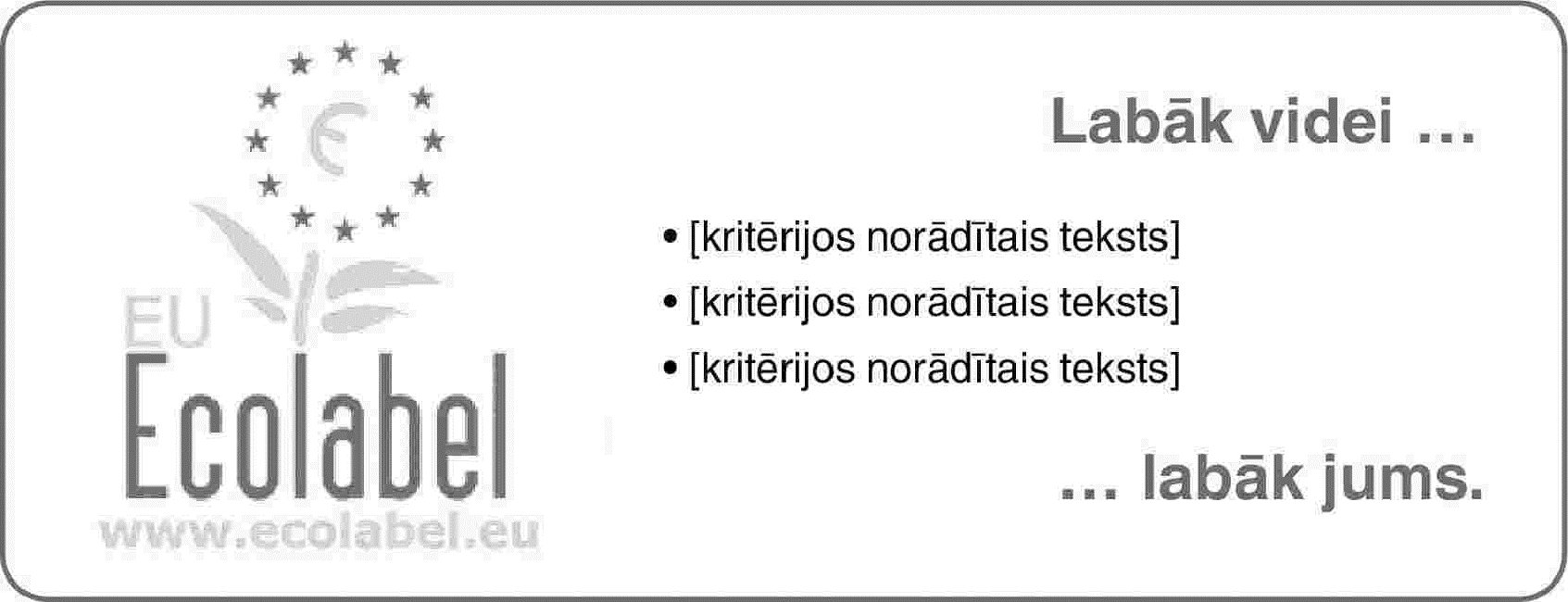
Uz produkta norāda arī ES ekomarķējuma reģistrācijas numuru. Tam ir šāda forma:

kurā xxxx apzīmē reģistrācijas valsti, yyy – produktu grupu un zzzzz – kompetentās iestādes piešķirto numuru.
Turpmākus norādījumus par ES ekomarķējuma logotipa dizainu un izmantošanu Eiropas Komisija sniegs pēc apspriešanās ar ES Ekomarķējuma komiteju atsevišķā vadlīniju dokumentā.
▼M1
|
|
III PIELIKUMS
|
III PIELIKUMS 1.
Pieteikuma maksa
Kompetentā iestāde, kurai iesniedz pieteikumu, iekasē maksu par pieteikuma apstrādi. Šī maksa nav mazāka par EUR 200 un nav lielāka par EUR 2 000 . Maziem un vidējiem uzņēmumiem (
6
) un jaunattīstības valstu uzņēmējiem maksimālā pieteikuma maksa nepārsniedz EUR 600. Mikrouzņēmumiem (
7
) pieteikuma maksimālā gada maksa ir EUR 350. Pretendentiem, kuri reģistrēti saskaņā ar Vides pārvaldības un audita shēmu (EMAS), pieteikuma maksu samazina par 30 %, bet tiem, kuri ir sertificēti saskaņā ar ISO 14001 standartu, pieteikuma maksu samazina par 15 %. Samazinājumi nav kumulatīvi. Ja pretendents reģistrēts saskaņā ar abām sistēmām, piemēro tikai lielāko samazinājumu. Minētais samazinājums ir atkarīgs no nosacījuma, ka pretendents skaidri apņemas nodrošināt savu produktu ar ekomarķējumu pilnīgu atbilstību ES ekomarķējuma kritērijiem visā līguma spēkā esības laikā un ka viņa apņemšanās ir attiecīgi iekļauta viņa vides politikā un sīki izstrādātos vides aizsardzības mērķos. Kompetentās iestādes var iekasēt maksu par licences grozīšanu vai pagarināšanu. Tās apjoms nepārsniedz pieteikuma maksu, un tai piemēro arī iepriekš minētos samazinājumus. Ar pieteikuma maksu nesedz izmaksas saistībā ar trešo personu veiktām testēšanām, pārbaudēm un jebkādām pārbaudēm uz vietas, ko trešā persona vai kompetentā iestāde varētu pieprasīt. Pretendenti paši sedz minēto testēšanu un pārbaužu izmaksas. 2.
Gada maksa
Kompetentā iestāde katram pretendentam, kuram ir piešķirts ES ekomarķējums, var prasīt maksāt gada maksu. Tā var būt fiksēta vai arī balstīta uz gada laikā Savienībā tādu pārdoto produktu apjoma vērtību, kam ir piešķirts ES ekomarķējums. Maksājuma laikposmu sāk skaitīt no dienas, kad pretendentam piešķirts ES ekomarķējums. Ja maksu aprēķina kā procentuālo daļu no gadā pārdotā produktu apjoma vērtības, tā veido ne vairāk kā 0,15 % no minētās vērtības. Minētās maksas pamatā ir ražotāja cenas, ja produkts, kam ir piešķirts ES ekomarķējums, ir kvalitatīvs. Attiecībā uz pakalpojumiem minētās maksas pamatā ir to sniegšanas cenas. Lielākais ikgadējais maksājums par ražojumu grupu pretendentam ir EUR 25 000 . Ja pretendenti ir MVU, mikrouzņēmumi vai uzņēmēji no jaunattīstības valstīm, gada maksu samazina par vismaz 25 %. Ar gada maksu nesedz nekādas izmaksas, kas saistītas ar nepieciešamības gadījumā veiktu testēšanu, pārbaudi vai pārbaudi uz vietas. Pretendenti paši sedz šādas testēšanas un pārbaužu izmaksas. 3.
Pārbaudes maksa
Kompetentā iestāde var iekasēt pārbaudes maksu.
▼B
|
|
ANNEX IV STANDARD CONTRACT COVERING THE TERMS OF USE OF THE EU ECOLABEL
|
ANNEX IV
STANDARD CONTRACT COVERING THE TERMS OF USE OF THE EU ECOLABEL
PREAMBLE
The competent body(full title) hereinafter called ‘the competent body’,
registered at(full address), which for the purposes of the signature of this contract is represented by(name of person responsible),(full name of holder), in his capacity as producer, manufacturer, importer, service provider, wholesaler or retailer whose official registered address is(full address), hereafter called ‘the holder’, represented by(name of person responsible), have agreed the following with regard to the use of the EU Ecolabel, pursuant to Regulation (EC) No 66/2010 of the European Parliament and of the Council of 25 November 2009 on the EU Ecolabel (
8
), hereinafter ‘the EU Ecolabel Regulation’:
1. USE OF THE EU ECOLABEL
|
1.1.
|
The competent body grants the holder the right to use the EU Ecolabel for his products as described in the annexed product specifications, which conform to the relevant product group criteria in force for the periodadopted by the Commission of the European Communities on(date), published in the Official Journal of the European Union of(full reference), and annexed to this contract.
|
|
1.2.
|
The EU Ecolabel shall be used only in the forms stipulated in Annex II to the EU Ecolabel Regulation.
|
|
1.3.
|
The holder shall ensure that the product to be labelled complies throughout the duration of this contract with all the terms of use and provisions set out in Article 9 of the EU Ecolabel Regulation, at all times. No new application will be required for modifications in the characteristics of the products which do not affect compliance with the criteria. The holder shall however inform the competent body of such modifications by registered letter. The competent body may carry out appropriate verifications.
|
|
1.4.
|
The contract may be extended to a wider range of products than those initially foreseen, subject to agreement by the competent body, and subject to the condition that they belong to the same product group and that they also comply with its criteria. The competent body may verify that these conditions are met. The Annex detailing the product specifications shall be modified accordingly.
|
|
1.5.
|
The holder shall not advertise or make any statement or use any label or logo in a way which is false or misleading or which results in confusion with, or calls into question the integrity of, the EU Ecolabel.
|
|
1.6.
|
The holder shall be responsible under this contract for the manner in which the EU Ecolabel is used in relation to his product, especially in the context of advertising.
|
|
1.7.
|
The competent body, including its agents authorised for such purpose, may undertake all necessary investigations to monitor the ongoing compliance by the holder with both the product group criteria and the terms of use and provisions of this contract in accordance with the rules laid down in Article 10 of the EU Ecolabel Regulation.
|
2. SUSPENSION AND WITHDRAWAL
|
2.1.
|
In the event that the holder becomes aware that he is failing to meet the terms of use or provisions contained in Article 1 of this contract, the holder shall notify the competent body and refrain from using the EU Ecolabel until those terms for use or provisions have been fulfilled and the competent body has been notified thereof.
|
|
2.2.
|
Where the competent body considers that the holder has contravened any of the terms of use or provisions of this contract, the competent body shall be entitled to suspend or withdraw its authorisation to the holder to use the EU Ecolabel, and to take such measures as are necessary to prevent the holder from using it further, including such measures as are provided for in Articles 10 and 17 of the EU Ecolabel Regulation.
|
3. LIMITATION OF LIABILITY AND INDEMNITY
|
3.1.
|
The holder shall not include the EU Ecolabel as part of any guarantee or warranty in relation to the product referred to in Article 1.1 of this contract.
|
|
3.2.
|
The competent body, including its authorised agents, shall not be liable for any loss or damage sustained by the holder arising out of the award and/or use of the EU Ecolabel.
|
|
3.3.
|
The competent body, including its authorised agents, shall not be liable for any loss or damage sustained by a third party and arising out of the award and/or use, including advertising, of the EU Ecolabel.
|
|
3.4.
|
The holder shall indemnify and keep indemnified the competent body and its authorised agents against any loss, damage or liability sustained by the competent body, or its authorised agents, as a result of a breach of this contract by the holder or as a result of reliance by the competent body on information or documentation provided by the holder, including any claims by a third party.
|
4. FEES
|
4.1.
|
The amount of application fee and annual fee shall be defined in accordance with Annex III of the EU Ecolabel Regulation.
|
|
4.2.
|
Use of the EU Ecolabel is conditional upon all relevant fees having been paid in due time.
|
5. CONTRACT DURATION AND APPLICABLE LAW
|
5.1.
|
Except as provided for in Article 5.2, 5.3 and 5.4, this contract shall run from the date on which it is signed until (…) or until expiry of the product group criteria, whichever is sooner.
|
|
5.2.
|
Where the holder has contravened any of the terms of use or provisions of this contract within the meaning of Article 2.2, the competent body shall be entitled to treat this as a breach of contract entitling the competent body, in addition to the provisions in Article 2.2, to terminate the contract, by registered letter to the holder, at an earlier date than that set out in Article 5.1, within (a time period to be determined by the competent body).
|
|
5.3.
|
The holder may terminate the contract by giving the competent body three months' notice by registered letter.
|
|
5.4.
|
If the product group criteria as stated in Article 1.1 are extended without amendments for any period, and if no written notice of termination from the competent body has been given at least three months before the expiry of the product group criteria and of this contract, the competent body shall inform the holder at least three months in advance that the contract shall be automatically renewed for as long as the product group criteria remain in force.
|
|
5.5.
|
After the termination of this contract the holder may not use the EU Ecolabel in relation to the product specified in Article 1.1 and in the Annex to this contract, either as labelling or for advertising purposes. The EU Ecolabel may nevertheless, for a period of six months after the termination, be displayed on stock held by the holder or others and manufactured before the termination. This latter provision shall not apply if the contract has been terminated for the reasons set out in Article 5.2.
|
|
5.6.
|
Any dispute between the competent body and the holder or any claim by one party against the other based on this contract which has not been settled by amicable agreement between the contracting parties, shall be subject to the applicable law determined in accordance with Regulation (EC) No 593/2008 of the European Parliament and of the Council of 17 June 2008 on the law applicable to contractual obligations (Rome I) (
9
) and Regulation (EC) No 864/2007 of the European Parliament and of the Council of 11 July 2007 on the law applicable to non-contractual obligations (Rome II (
10
)).
The following Annexes shall form part of this contract:
—
a copy of Regulation (EC) No 66/2010 of the European Parliament and of the Council of 25 November 2009 on the EU Ecolabel, in (the relevant Community language(s)),
—
product specifications, which shall at least include details of the names, and/or the manufacturer's internal reference numbers, the manufacturing sites, and the related EU Ecolabel registration number or numbers,
—
a copy of Commission Decision (… on product group criteria),
|
Done at date
…
(Competent body)
Designated person
…
(Legally binding signature)
…
(Holder)
Designated person
…
(Legally binding signature)
|
|
ANNEX V REQUIREMENTS RELATING TO COMPETENT BODIES
|
ANNEX V
REQUIREMENTS RELATING TO COMPETENT BODIES
|
1.
|
A competent body shall be independent of the organisation or the product it assesses.
A body belonging to a business association or professional federation representing undertakings involved in the design, manufacturing, provision, assembly, use or maintenance of products which it assesses, may, on condition that its independence and the absence of any conflict of interest are demonstrated, be designated as a competent body.
|
|
2.
|
A competent body, its top-level management and the personnel responsible for carrying out the conformity assessment tasks shall not be the designer, manufacturer, supplier, installer, purchaser, owner, user or maintainer of the products which they assess, nor the authorised representative of any of those parties. This shall not preclude the use of assessed products that are necessary for the operations of the competent body or the use of such products for personal purposes.
A competent body, its top-level management and the personnel responsible for carrying out the conformity assessment tasks shall not be directly involved in the design, manufacture or construction, the marketing, installation, use or maintenance of those products, or represent the parties engaged in those activities. They shall not engage in any activity that may conflict with their independence of judgment or integrity in relation to conformity assessment activities for which they are designated. This shall in particular apply to consultancy services.
Competent bodies shall ensure that the activities of their subsidiaries or subcontractors do not affect the confidentiality, objectivity or impartiality of their conformity assessment activities.
|
|
3.
|
Competent bodies and their personnel shall carry out the conformity assessment activities with the highest degree of professional integrity and the requisite technical competence in the specific field and shall be free from all pressures and inducements, particularly financial, which might influence their judgment or the results of their conformity assessment activities, especially as regards persons or groups of persons with an interest in the results of those activities.
|
|
4.
|
A competent body shall be capable of carrying out all the conformity assessment tasks assigned to it by this Regulation, whether those tasks are carried out by the competent body itself or on its behalf and under its responsibility.
At all times and for each conformity assessment procedure and each kind or category of products in relation to which it has been designated, a competent body shall have at its disposal the necessary:
(a)
technical knowledge and sufficient and appropriate experience to perform the conformity assessment tasks;
(b)
descriptions of procedures in accordance with which conformity assessment is carried out, ensuring the transparency and the ability of reproduction of those procedures. It shall have appropriate policies and procedures in place that distinguish between tasks it carries out as a competent body and other activities;
(c)
procedures for the performance of activities which take due account of the size of an undertaking, the sector in which it operates, its structure, the degree of complexity of the product technology in question and the mass or serial nature of the production process.
It shall have the means necessary to perform the technical and administrative tasks connected with the conformity assessment activities in an appropriate manner and shall have access to all necessary equipment or facilities.
|
|
5.
|
The personnel responsible for carrying out conformity assessment activities shall have the following:
(a)
sound knowledge covering all the conformity assessment activities in relation to which the competent body has been designated;
(b)
the ability to draw up certificates, records and reports demonstrating that assessments have been carried out.
|
|
6.
|
The impartiality of the competent bodies, of their top level management and of the assessment personnel shall be guaranteed.
The remuneration of the top-level management and assessment personnel of a competent body shall not depend on the number of assessments carried out or on the results of those assessments.
|
|
7.
|
Competent bodies shall participate in, or ensure that their assessment personnel are informed of, the relevant standardisation activities and the activities of the working group of competent bodies referred to in Article 13 of this Regulation and apply as general guidance the administrative decisions and documents produced as a result of the work of that group.
|
|
,
1.1 Atsauces
1.2 Identificētās prasības
1.3 Saistītie standarti
2. Identificētās prasības
3. Saistītie standarti
|